
In professional practice, fashion research is the structured process of collecting evidence before creating aesthetics.
A garment is not first drawn — it is first understood.
Research answers a simple but powerful question:
Why should this design exist in the present moment of society?
Fashion operates inside a network of influences:
Human behaviour → social mood → lifestyle shift → visual language → product
Therefore, fashion research is the study of people before it becomes the study of clothes.
| Layer | What It Studies | Result in Design |
| Cultural | Society, economy, technology, psychology | Theme & narrative |
| Behavioural | Consumer habits & preferences | Function & silhouette |
| Visual | Colour, material, surface | Final aesthetic |
Without these three layers, design becomes decoration rather than communication.
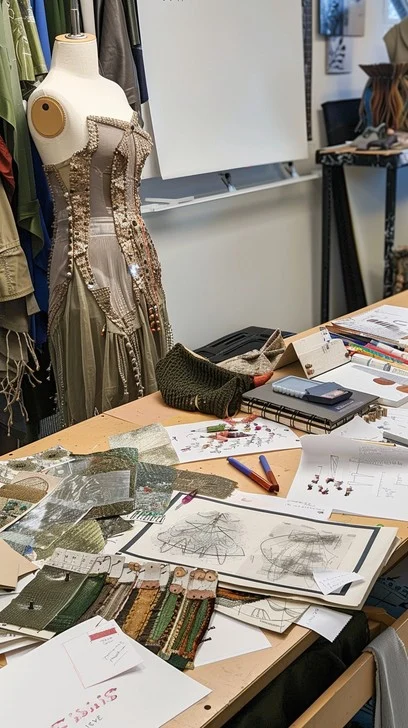
Fashion is created months before it is worn. A designer therefore designs for a future emotional state of the consumer. Research exists to reduce uncertainty.
1. Relevance Design must align with social context — not personal taste.
2. Commercial Viability Brands invest large capital in production. Research ensures the product sells.
3. Sustainability Accurate prediction reduces overproduction and waste.
4. Professional Credibility A designer who explains “why” earns industry trust faster than a designer who only shows “what”.
Fashion research follows academic logic. It uses two complementary systems:

This is first-hand observation.
Observation Studies
Record:
Interviews Speak to different age groups, professions, and lifestyles.
Ask:
Material Interaction Handle real objects:
Study:
Photographic Documentation Capture micro details, not only outfits. Fashion lives in: creases, distortion, usage marks, repetition.
This validates observations.
Sources include:
Secondary research explains why behaviour exists.
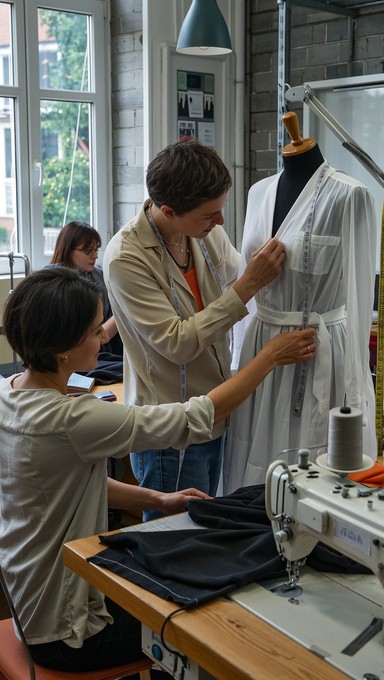
Students often collect references randomly. Professional research focuses on specific categories.
Social
Psychological
Material
Retail
Aesthetic
Forecasting companies convert scattered global signals into structured knowledge.
They operate as collective intelligence systems for the fashion industry. Designers do not work alone — they work with global behavioural databases.
Forecasting agencies analyse:
Their reports help brands design for future seasons.
These agencies interpret long-term lifestyle evolution.
These track real-time product performance.
These analyse millions of consumer images to detect rising patterns before retail adoption.
Earlier: Designers observed trends.
Now: Systems measure behaviour at scale.
AI can identify:
This transforms forecasting from opinion to probability.
The modern workflow is:
Observation → Hypothesis → Data Validation → Design
Students often research randomly. In reality, the industry works on a strict calendar.
| Season | Research Begins | Design Begins | Retail Launch |
| Spring/Summer | 24 months before | 18 months before | Current year |
| Autumn/Winter | 24 months before | 16–18 months before | Current year |
| Fast Fashion | 3–6 months before | 1–2 months before | Immediate |
| Couture | Cultural research continuous | Concept driven | Event based |
Key Learning: You are not designing for today’s mood. You are designing for the mood that will exist when the garment reaches stores.
Slow social changes Examples:
These define direction
Visual expressions Examples:
These define appearance
Macro trend explains why Micro trend explains how
A strong project connects both.
The Translation Pyramid (How Research Becomes a Garment)
Students must follow a hierarchy:
SOCIAL SHIFT ↓ EMOTION ↓ AESTHETIC LANGUAGE ↓ TEXTILE DEVELOPMENT ↓ GARMENT CONSTRUCTION ↓ STYLING
If students jump directly to sketching, the design feels superficial.
Forecast agencies do not pick colours randomly.
They consider:
Emerging → Acceptance → Peak → Saturation → Decline → Revival
Students should justify colour choice based on lifecycle stage.
Every design must answer:
Design without retail thinking is illustration, not fashion.
Every project research file should include:
This converts a portfolio into professional evidence.
Students should train these abilities weekly:
Fashion industry hires thinkers before illustrators.
Forecasting is not copying trends. It is interpreting society responsibly.
Designers must avoid:
Research helps designers design with awareness, not imitation.
The industry is shifting toward:
The designer’s role is evolving from stylist to decision strategist. A successful fashion student does not present a collection. They present a conclusion. When research, forecasting and design align, the portfolio stops looking academic and starts looking employable. A strong portfolio does not show inspiration boards. It shows reasoning.
Fashion education changes when students stop asking:
What should I design?
and begin asking:
What does society need next?
Research makes a designer employable. Forecasting makes a designer dependable. Evidence makes a designer professional.
Design begins when intuition meets verification.
Prepared as an academic learning reference for fashion students and educators globally, including curriculum discussions in contemporary design education environments such as Dezyne École College, By Dr.Vinita Mathur , Principal /President , Academician